+86 (0)574 62837603


When a pump or valve starts leaking, the first question buyers usually ask is: "Which gland packing should I choose?" Many then compare temperature ratings first. A 650 °C graphite packing looks safer than a 260 °C PTFE packing — but in real applications, a higher temperature rating does not always mean longer service life, or a lower total cost.
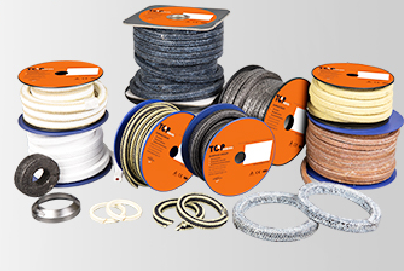
Three common cases show why:
The best packing is not the one with the highest temperature rating. It is the one matched to the actual operating condition. This guide shows how to get there — covering gland packing selection, pump packing selection and valve packing selection in the order a buyer actually needs them.
|
Application |
Recommended Direction |
Why |
Avoid Choosing Only By |
|
Chemical pump |
PTFE-based packing |
Chemical resistance + low friction |
Temperature rating |
|
Steam valve |
Graphite packing |
High temperature + thermal cycling |
Peak temperature only |
|
Hot water pump |
PTFE / graphite composite |
Balance sealing and wear |
Temperature alone |
|
Slurry pump |
Aramid-reinforced packing |
Abrasion resistance |
Chemical resistance alone |
|
Food processing pump |
Virgin PTFE packing |
Clean service and chemical inertness |
Cost alone |
|
Solvent pump |
PTFE or special chemical packing |
Low absorption |
Physical strength alone |
The recommendations below are starting points, not universal replacements. Final selection depends on the actual medium, temperature, pressure, speed and equipment design. Use the "Why" column to understand the logic and the "Avoid Choosing Only By" column to see which single factor most often misleads buyers, then confirm against your own conditions in the seven factors below.
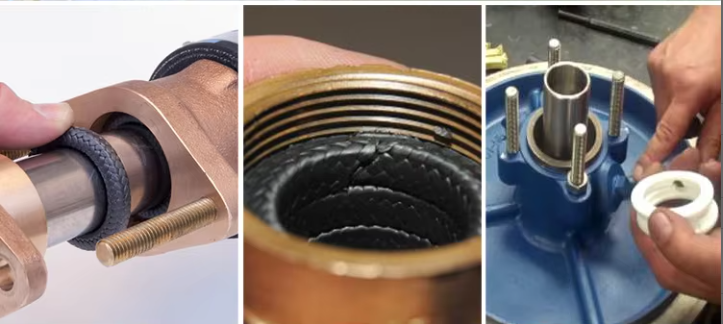
The first question is not "what is the temperature?" It is "what type of equipment is being sealed?" The two fail differently.
What this means for a buyer: ask for a "pump service" recommendation and a "valve service" recommendation separately. A single recommendation that ignores equipment type is a red flag before you look at any number.
|
Medium |
Main risk |
Packing direction |
|
Acid / chemical |
Corrosion of packing and shaft |
PTFE-based |
|
Steam |
Temperature + extrusion |
Graphite |
|
Solvent |
Swelling / loss of structure |
PTFE or FKM-based |
|
Food process |
Contamination of product |
Virgin PTFE |
Chemical resistance is not a single pass/fail value. Both expanded graphite and PTFE cover pH 0–14 (except strongly oxidizing media for graphite); aramid is narrower at pH 2–12. The practical question is not "will the packing dissolve" but "how fast will the medium and temperature together change its structure."
What this means for a buyer: give the actual chemistry, not a category. "Chemical pump" is not a medium — the acid type, its concentration and the presence of solids change the recommendation.
Match the continuous rating to the continuous operating temperature — not to the design peak. Graphite's real ceiling depends on atmosphere (~455 °C in air / 650 °C in steam), PTFE's is about 260 °C, and aramid sits near 250 °C with steam limited to roughly 180 °C.
Higher pressure drives extrusion: the packing is pushed into the clearance gap between shaft and gland. High-pressure, large-clearance services call for denser, higher-recovery constructions and, for graphite especially, anti-extrusion support.
Speed raises friction heat, and friction heat ages every packing faster. The higher the surface speed, the more the selection tilts toward low-friction, self-lubricating constructions rather than toward the material with the highest temperature number.
The same base fiber behaves differently depending on braid and impregnation. Through-impregnated yarns, corner-reinforced braids and pre-lubricated structures change chemical resistance, friction and recovery — this is often the variable that turns an unsuitable base material into an acceptable one.
Installation quality is a major contributor to packing leakage. Poor alignment, improper assembly and insufficient lubrication will shorten packing service life. For static gaskets, many failures come from incorrect compression. When you install gland packing correctly, you avoid many preventable leaks.
What this means for a buyer: proper installation directly impacts your sealing performance. Even premium packing will leak with poor fitting.
Temperature ratings are usually safe-side figures taken from a material's best-case environment. Graphite packing carries a continuous rating of about 455 °C (850 °F) in air and up to 650 °C (1,200 °F) in steam. The gap is chemistry, not marketing — in air, oxygen attacks the graphite lattice and oxidation begins between 350 °C and 450 °C, while steam partly excludes oxygen and raises the ceiling. Buying on the headline number, without its atmosphere attached, means comparing figures that were never measured under the same conditions.
Note on reading temperature ratings: these values are not maximum failure temperatures. They are service recommendations under specific environmental conditions.
|
Material |
Continuous temperature |
pH range |
Main weakness in service |
|
PTFE |
−200 to +260 °C |
0–14 |
Cold flow / creep under sustained load |
|
Expanded graphite |
~455 °C in air / 650 °C in steam |
0–14 |
Oxidation in air; extrusion at high pressure |
|
Aramid (para-aramid) |
−100 to +250 °C (steam ~180 °C) |
2–12 |
Degradation in strong acids and bases |
Temperature tells you whether a material survives. Compression recovery tells you whether it keeps sealing. PTFE gland packing is chemically excellent and thermally adequate for a very large share of services, but under sustained compressive load it creeps — cold flow. As the packing continues to deform, the gland load decays, contact pressure against the shaft drops.
What this means for a buyer: creep does not appear on a datasheet as a single number, but it appears on the plant as frequent gland adjustment, or as a leak that returns a few weeks after every re-tightening. A packing that keeps needing follow-up tightening usually has a recovery problem, not a temperature problem.
Many packing failures happen because buyers select materials first and operating conditions second. This is also why SUNPASS recommends starting with equipment type and service condition rather than choosing from temperature ratings alone. Selection should run from the operating condition outward — equipment type first, then medium, temperature, pressure, shaft speed, structure and installation.
To get an accurate recommendation on the first try:
SUNPASS specializes in the manufacturing and customization of braided compression packing, covering more than 40 styles of gland packing — PTFE, graphite, aramid, carbon, acrylic and non-asbestos constructions. Our PTFE-based packings use high-quality PTFE materials, including POLYFLON PTFE from Daikin, which provides continuous service temperatures up to 260 °C and excellent chemical resistance for selected applications.
We supply pumps, valves, mixers and rotating equipment across the chemical, petrochemical, pharmaceutical, food, pulp and paper, and power industries. Every batch ships with tensile strength test reports, raw material certificates and performance inspection records, and we provide OEM and custom formulations for specific chemistries and braiding requirements, with export experience to global industrial buyers.
SUNPASS builds packing recommendations from the operating condition outward — equipment type first, then medium, temperature, pressure, shaft speed, structure and installation.
The goal is not to select the highest-rated packing, but the most suitable packing for the actual operating condition. That single sentence is the whole philosophy behind our selection support, and the one idea worth taking away from this guide.
Q1. Why does gland packing leak? Leakage usually comes from three sources: wrong material for the medium or temperature, lost compression recovery (creep) that lets the gland load decay, and installation or shaft-condition problems. Over-tightening the gland to stop the leak adds friction heat and accelerates the next failure.
Q2. What is the best gland packing for a centrifugal pump? There is no universal best packing. For centrifugal pumps, PTFE-based packing is often selected for chemical resistance and low friction, while aramid-reinforced packing is considered where abrasion resistance matters more. The right choice depends on the medium, temperature, pressure and shaft speed.
Q3. What is the difference between PTFE packing and graphite packing? PTFE packing leads on chemical resistance (pH 0–14) and low friction, with a continuous rating near 260 °C; its weakness is creep under sustained load. Graphite packing leads on temperature (about 455 °C in air, 650 °C in steam) and thermal conductivity, with a weakness of oxidation in air and extrusion at high pressure. The choice usually follows the service: chemical and food duty favors PTFE; steam and high-temperature duty favors graphite.
Q4. How do I choose packing size? Size is set by the stuffing-box dimensions, not by the medium. Measure the shaft diameter and the stuffing-box bore and depth, then select a square cross-section that fills the box correctly. A wrong-size packing ring is one of the fastest routes to leakage regardless of material.
Q5. How do I choose packing for a pump versus a valve? For a pump, the priorities are low friction, self-lubrication and abrasion resistance, because shaft speed drives friction heat and wear. For a valve, the priorities are compression retention and anti-extrusion, because the stem moves slowly and the packing must hold sealing force through thermal cycles.
Q6. How often should gland packing be replaced? There is no fixed replacement interval. Service life depends on the medium, shaft condition and surface finish, speed, temperature and installation quality. In practice, replacement is triggered by indicators rather than a calendar: leakage that gland adjustment can no longer control, rising stuffing-box heat or pump power draw, and visible hardening, cracking or powdering of the packing.
Q7. What is the difference between pump packing and valve packing? Pump packing is designed for dynamic rotating service, where friction, shaft speed and wear are major concerns. Valve packing is designed mainly for stem sealing, where compression retention, extrusion resistance and emission control are more important.
Q8. Can PTFE packing replace graphite packing? Sometimes, but not always. PTFE is preferred where chemical resistance and low friction are critical, while graphite is preferred for high-temperature steam and thermal cycling applications.
Sunpass Sealing Technology (Zhejiang) Co. LTD
• Zhejiang Top Sealing and Insulation Co.,Ltd.
• Echo Industry Limited
• Tenglong Sealing and Thermal Insulation Manufactory
 English
 русский
 Español
 Add: No. 78 West Road Zhenxing, Lianghui Industry Zone, Yuyao, Zhejiang, China
 Tel: +86 574 62837603
 E-mail: