How the ring is actually built
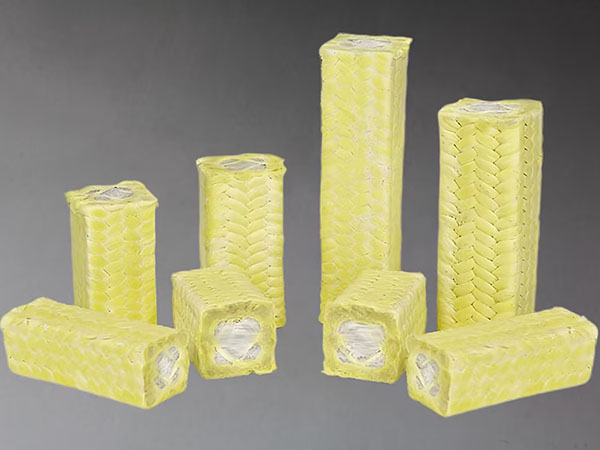
Flexible graphite packing begins as expanded graphite yarn, braided into a square or rectangular section. The braid matters more than the yarn grade in most failure investigations, because braid density and interlace determine whether the cross‑section is uniform, and uniformity determines how load distributes through the sta
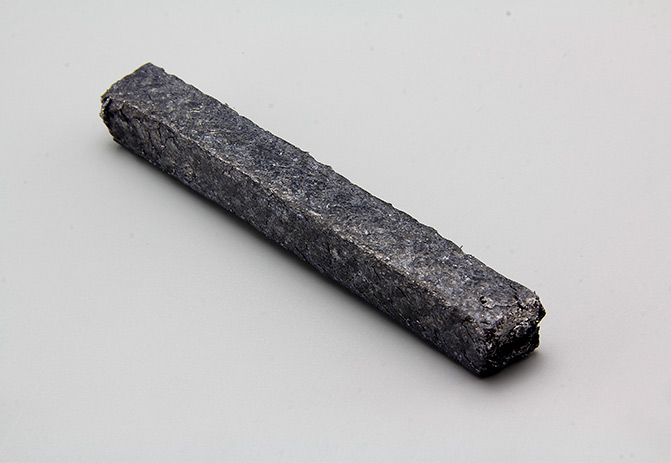
Then come the additions. A reinforcement may be glass fibre, cotton, carbon, aramid or metal wire. An impregnant may be a PTFE emulsion, a graphite dispersion, an oil, or a blocking agent. Those additions are not cosmetic; they set the service envelope. Published data for three styles from the same family shows the spread:
| Style |
Construction |
Temperature |
Pressure / speed |
| SUNPASS Style 5000 |
Expanded graphite yarn, no reinforcement |
−100 to +450 °C |
30 / 100 / 300 bar (pump / valve / static) |
| SUNPASS Style 5200 |
Graphite with PTFE emulsion impregnant |
−240 to +260 °C |
2 m/s, pH 2–12 |
| SUNPASS Style 5800MESH |
Low‑sulphur graphite yarn, Inconel wire jacket |
+316 °C non‑oxidising, +454 °C oxidising, +649 °C steam |
450 bar in steam |
Same material family, three very different ceilings. That is the first thing to understand before blaming the graphite: in a finished packing, the weakest element sets the limit, and the weakest element is usually not the graphite.
Corner reinforcement deserves separate mention because it changes mechanics rather than chemistry. Styles that weave a different fibre into the four corners, aramid, carbon or Kynol‑type, keep the braid from opening at the edges, where an extrusion lip begins. The trade‑off is friction: harder corners grip the stem harder, so a corner‑reinforced ring in a badly worn box can score a shaft that a softer ring would have tolerated. The published limits reflect that compromise rather than the graphite. One corner‑reinforced style in the same catalogue, SUNPASS Graphite Packing with Kynol Corner, is rated to 300 °C at 40 / 75 / 150 bar, well below a plain graphite yarn.
Pressure pushes; it does not embrittle
Pressure acts on the packing from the bore side and tries to drive material into the clearance between stem and box. Whether it succeeds depends on the size of that clearance, the pressure across it, and the temperature, which softens the braid and lowers its resistance to flow.
The force involved is easy to underestimate. Take a 50 mm shaft in a box bored to 70 mm, carrying 10 mm packing. The annular area the pressure can act on is about 1,900 mm², so at 40 bar the stack sees an axial thrust of roughly 7.5 kN. That is not enormous, but it does not need to be. It only has to exceed the friction and confinement holding the rings in place, and it acts continuously, at every cycle, in the same direction.
Gland load is a separate quantity. It is applied axially by the follower and it decays down the stack, so the bottom rings always see less than the top unless the stack was built with that in mind. This is why "tighten until it stops leaking" produces a box that is over‑compacted at the top and under‑compacted at the bottom: the ring doing the sealing is the one nobody loaded properly.
Pressure cycling makes both worse. Each cycle re‑aims the load, works the packing against the stem, and consumes a little of the recovery that would otherwise let the stack re‑seat. A packing that is comfortable in steady service can fail in cycling service without any change in temperature or chemistry.
Where brittleness and voids actually come from
The impregnant leaves first
The part of a graphite packing that makes it feel like a packing rather than a stick of carbon is the impregnant. PTFE emulsions, oils, resins and blocking agents each have a thermal ceiling and a characteristic way of disappearing. Some migrate under load; some carbonise into a hard residue; some leave a brittle crust that cracks when the ring is flexed.
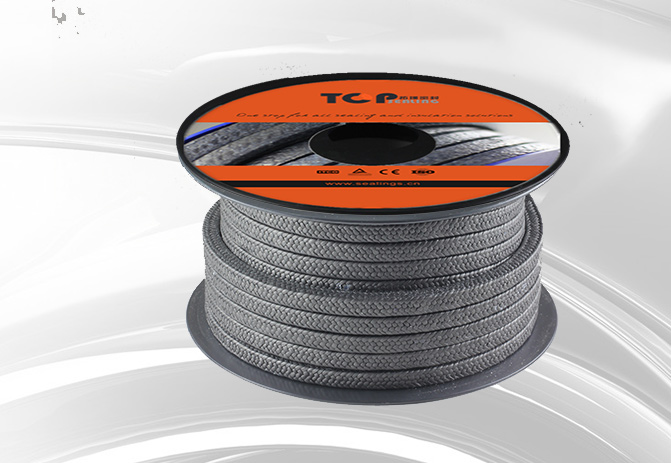
Graphite Packing
This explains a common confusion. A ring that feels hard and snaps is often perfectly good graphite carrying a dead binder. Nothing about the graphite changed. If the investigation stops at "the material went brittle", it will keep replacing a material that was never the problem.
Be careful with chemistry claims here. It is not safe to state that a given impregnant decomposes at a given temperature across all products; formulation, loading and atmosphere all move the number. Ask the supplier for the impregnant's own limit rather than inferring it from the packing's headline rating.
Oxidation, and why one temperature is never enough
Graphite oxidises in the presence of oxygen. The rate depends on temperature, time, atmosphere and grade, and the practical result is that a single "maximum temperature" is a simplification that occasionally becomes a trap.
The SUNPASS Style 5800MESH data above is the clearest illustration available: one product, three ceilings, depending on whether the service is non‑oxidising, oxidising or steam. If the duty is air or an oxygen‑rich stream, the lowest number governs. If it is steam, the steam number governs and the non‑oxidising number is irrelevant. A specification that quotes the highest figure is specifying a packing for a duty it will not survive.
Oxidation has a direction. It eats from the exposed faces inward, so an oxidised ring is often friable outside and still sound at the core, loses mass, and leaves powder rather than crumbs. That pattern is worth photographing, because it distinguishes oxidation from mechanical damage, which tends to concentrate where the load and motion are.
Oxidation can also accelerate itself. As the accessible binder and graphite are consumed, the packing loosens, hot gas finds new paths through it, and the local temperature along that path rises. The result is a failure that looks sudden after a long period of apparently acceptable service.
Braid defects, and the problem of proving them
Uneven braid density, discontinuous reinforcement, damaged yarn and inconsistent section all produce packing that fails early. They are real failure modes, and they are also the most over‑diagnosed, because the evidence usually disappears during removal.
A ring that has been compressed for a year, baked, and then pulled from a box with a corkscrew cannot tell you what its braid looked like when it was made. The evidence for a manufacturing defect is the original cross‑section, the production record, or incoming inspection data. Without one of those, "bad braiding" is a hypothesis wearing the clothes of a conclusion.
Over‑compaction leaves a signature
A crushed packing is dense, hard and unresponsive. It also loses the porosity that lets it distribute load and hold lubricant, which is why over‑compacted rings often fail by leaking rather than by wearing out.
The signature is a section that is thinner and harder toward the gland end, with the top rings in visibly worse condition than the bottom ones. That reverses the usual assumption, and it indicates the gland has been doing work the packing was supposed to do.
The extrusion and wear loop
Extrusion removes section; less section carries less load; uneven load accelerates local wear; wear opens clearance; more clearance means more extrusion. Once this loop is running, gland adjustment cannot stop it, because the geometry driving it gets worse with every turn.
One possible path, not a universal one: impregnant loss → local extrusion or material loss → uneven load → over‑compaction and structural damage → voids and loss of integrity.
Real failures often skip steps, run two branches at once, or start in the middle. The sequence is useful because each stage leaves different evidence, and the earliest stage is the cheapest to fix.
What each failure looks like
| What you see |
What it usually means |
What to check before concluding |
| Cracks when flexed, hard throughout |
Impregnant degraded or lost |
Temperature, atmosphere, impregnant type, time in service |
| Friable, powdery, lighter than new |
Oxidation |
Oxygen content, steam or air, temperature and duration |
| Cracked only on outer faces |
Oxidation plus thermal cycling |
Gas path, gland condition, insulation |
| Extruded lip at bore or OD |
Clearance too large for duty |
Box bore, stem wear, pressure, temperature |
| Thin, dense, hard at gland end |
Over‑compaction |
Gland load history, number of adjustments |
| Voids in the section |
Original structure, or damage during removal |
A cut section, not a pulled ring |
| Powder and stem scoring |
Abrasive wear |
Stem finish, medium, filtration |
Two appearances can share a cause: a ring that cracks may be oxidised, over‑compacted, or simply cold and dry. The table lists things to check, not a diagnosis.
Diagnosing without destroying the evidence
Begin with the record: temperature and pressure, medium, atmosphere, cycle frequency, and the date weeping started. A packing that hardened in three weeks at 300 °C in air has a different story from one that hardened over two years in steam, and the two call for different products.
When the equipment comes apart, cut one ring through the section before extracting the stack. Once the rings are out, the internal structure is gone and every void becomes ambiguous. Keep the rings in order, top to bottom and in their original orientation: the load gradient through the stack is often the most informative evidence in the job, and it is destroyed the moment everything goes into a bucket.
A crude but useful field check: cut a fixed length of used packing and the same length of new, then compare mass. A large loss suggests oxidation or material loss; a large gain suggests contamination, swelling or compacted debris. It is a screening indicator, not a specification test, but it costs nothing.
Then measure the box: bore, stem diameter, clearance, stem condition. A worn stem is a packing failure waiting to happen, and no specification compensates for it.
A cut section also shows where the ring was actually working. A polished, compressed band on the inside diameter means contact. A band that is shiny on one side and dull on the other means the ring sat off‑centre, which usually points to a gland that is not square to the stem rather than to the packing itself.
Changing the outcome
Selection should follow the failure mode rather than the catalogue hierarchy. If the history is extrusion, a wire‑jacketed or corner‑reinforced construction adds mechanical resistance at the clearance. If the stem is worn, a construction that conforms and carries lubricant seats better than a dense one. If the atmosphere is oxidising, the atmosphere‑specific limit governs regardless of how good the construction is.
Geometry is not negotiable. Verify box dimensions, section size, clearance and stem condition before choosing a product. Repacking a worn box is how a correct packing acquires a reputation for failing.
If the duty cycles hard, think about how the stack is built as well as what it is made of. Five rings of a softer construction that can re‑seat will often outlast three rings of a dense one that cannot, and a lantern ring in the right position gives the packing a flush path that no impregnant can match over a long run.
Installation decides whether the first month resembles the first year. Rings go in one at a time, joints staggered about 90°, cut to length rather than forced, seats cleaned of old packing. Bring the gland to hand contact, then add load in small increments while the equipment runs, letting the packing seat between adjustments. A stack taken to full load in one movement is being pre‑damaged, and a run‑in target of zero leakage usually guarantees over‑compaction.
What to ask before you buy
Ask what the construction is, in enough detail to picture the cross‑section: braid type, reinforcement, corner treatment. Ask what the impregnant is and what its own temperature and atmosphere limits are, not the packing's headline number. Ask whether the product suits the specific medium and concentration, and whether there is application data near the duty rather than a catalogue limit. Ask for a cross‑section photograph and a TDS. A supplier who can answer these is describing a product; one who cannot is describing a price.
FAQ
Q1: How long can graphite packing last?
A1: There is no honest general figure. Life depends on temperature, atmosphere, medium, stem condition, gland adjustment and cycle frequency. A supplier quoting years without asking those questions is quoting an average of other people's applications.
Q2: Can used graphite packing be reinstalled?
A2: Physically yes. Practically, it has lost part of its resilience and lubricant reserve, and its shape now matches the old compression pattern rather than a clean box. It is a field improvisation, not a maintenance strategy.
Q3: When should packing be replaced instead of adjusted?
A3: When adjustment no longer reduces leakage, when the rings have hardened or cracked, when the stem or shaft is worn, or when leakage changes quickly after each adjustment. Adding load to a hardened packing accelerates stem wear and rarely restores the seal.
Q4: Does harder packing resist pressure better?
A4: No. Hardness is not a pressure rating. Extrusion resistance comes from confinement, reinforcement and clearance control. A hard ring that cannot conform loads unevenly and tends to leak at the first thermal cycle.

 +86 (0)574 62837603



 English
 русский
 Español
 Add: No. 78 West Road Zhenxing, Lianghui Industry Zone, Yuyao, Zhejiang, China
 Tel: +86 574 62837603
 E-mail: